Python Course Syllabus — Complete 8-Week Curriculum
Week-by-week Python programming syllabus: fundamentals, OOP, Pandas, web scraping, Flask APIs, capstone project & placement preparation — as taught at Asmorix Pondicherry.
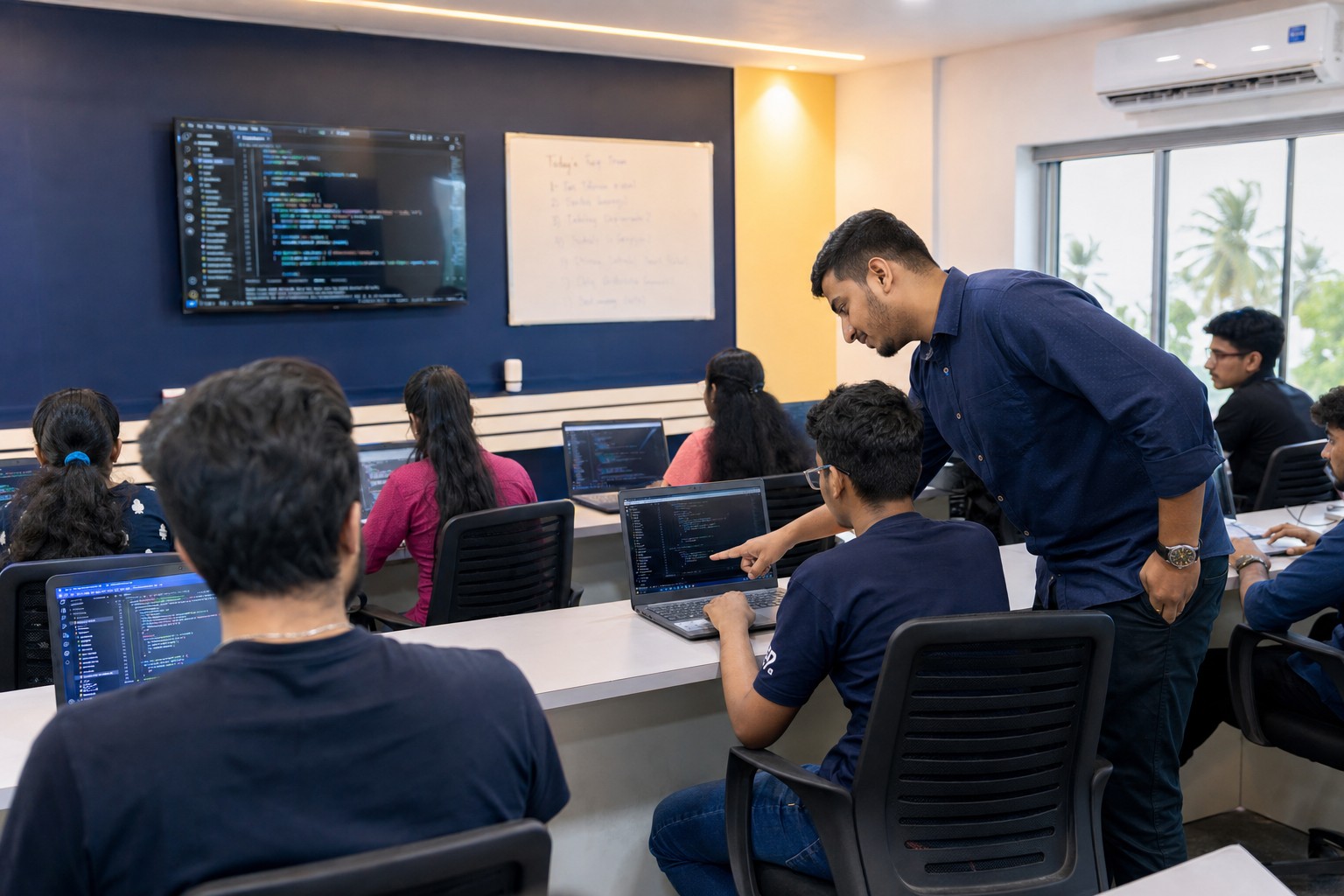
This is the complete Python course syllabus taught at Asmorix Technologies, Pondicherry — an 8-week, instructor-led program for beginners, freshers, and career switchers. Whether you are comparing institutes, preparing for counselling, or planning self-study, this page lists every week, topic, tool, and project so you know exactly what you will learn before you enrol.
Unlike scattered video playlists, our syllabus is built for job-ready outcomes: Python fundamentals → OOP → automation → Pandas → APIs → capstone on GitHub → placement mocks. In 2026 we also integrate AI-assisted coding (ChatGPT debugging, GitHub Copilot) the way real teams work. Duration: 2 months (8 weeks). Same syllabus for weekday and weekend batches.
Python Syllabus Overview — Who It Is For
This syllabus suits:
- College students (any stream) who want a first IT job as Python developer or automation engineer
- Freshers with zero coding — we start from installation and variables
- Working professionals upskilling into scripting, data analysis, or backend roles
- Career switchers from B.Com, BBA, mechanical, or arts backgrounds
After completion, typical roles include Junior Python Developer, Automation Engineer, Data Analyst (with Pandas), and API support roles. For a broader analytics path, see our data analytics training or the data analytics career guide without experience.
Tools & Libraries in the Syllabus
| Category | Tools | When in syllabus |
|---|---|---|
| Language & IDE | Python 3, VS Code, Jupyter, PyCharm | Week 1–2 |
| Core Python | Built-ins, venv, pip, modules | Week 1–5 |
| Data | NumPy, Pandas, Matplotlib, Seaborn | Week 6 |
| Web & APIs | Requests, BeautifulSoup, Flask | Week 7 |
| DevOps basics | Git, GitHub, README portfolio | Week 8 |
| AI productivity | ChatGPT, GitHub Copilot (debugging workflows) | Throughout |
Students aiming for pure data roles may later add SQL training and Power BI. For ML depth, explore data science training after mastering this Python syllabus.
Week-by-Week Python Course Syllabus (Detailed)
Below is the exact module breakdown. Each week ends with practice exercises and at least one mini-project where noted.
Week 1–2: Python Fundamentals (Days 1–14)
- Introduction to Python — history, installation, VS Code, PyCharm, Jupyter
- Variables & data types: int, float, str, bool, NoneType, dynamic typing
- Operators: arithmetic, comparison, logical, bitwise, assignment, identity
- I/O: print(), input(), f-strings, format(), string methods
- Control flow: if / elif / else, nested conditions, ternary expressions
- Loops: for, while, range(), break, continue, pass, else in loops
- Functions: def, parameters, *args, **kwargs, return, docstrings
- Scope: local, global, nonlocal — LEGB rule
- Mini-projects: calculator, number guesser, FizzBuzz, Fibonacci
Week 3: Data Structures (Days 15–21)
- Lists — indexing, slicing, methods, comprehensions, nested lists
- Tuples — immutability, packing/unpacking, named tuples
- Sets — union, intersection, difference, frozenset
- Dictionaries — CRUD, defaultdict, OrderedDict, dict comprehension
- Strings & regex basics with the re module
- Interview-style problems on lists, dicts, and strings
Week 4: Object-Oriented Programming (OOP) (Days 22–28)
- Classes & objects — __init__, self, instance vs class variables
- Inheritance — single, multiple, multilevel, MRO
- Encapsulation — private/protected, @property
- Polymorphism — overriding, operator overloading, duck typing
- Abstraction — ABC module
- Dunder methods — __str__, __repr__, __len__, __eq__
- Mini-project: bank account system, library management OOP
Week 5: File Handling, Modules & Automation (Days 29–35)
- File I/O — open(), read/write/append, with, context managers
- CSV with csv module and Pandas read_csv / to_csv
- JSON — loads(), dumps(), reading/writing JSON files
- OS & pathlib — file system operations
- Exception handling — try/except/else/finally, custom exceptions
- Modules, packages, pip, virtual environments
- Automation — bulk rename, folder organiser, smtplib email
- Project: PDF report generator, bulk file organiser
Week 6: NumPy, Pandas & Data Visualisation (Days 36–42)
- NumPy — ndarrays, broadcasting, reshape, indexing
- Pandas — Series, DataFrame from CSV, Excel, JSON, SQL
- Data cleaning — missing values, duplicates, dtypes
- groupby, merge, join, pivot_table, apply()
- Matplotlib — line, bar, scatter, histogram, pie charts
- Seaborn — heatmaps, pairplots, boxplots
- EDA project on a real dataset (Zomato / IPL / Titanic)
Week 7: Web Scraping & REST APIs (Days 43–49)
- HTTP — GET, POST, status codes, headers, auth
- Requests library — APIs, query params, JSON responses
- REST APIs — OpenWeather, NewsAPI, CoinGecko
- BeautifulSoup — HTML parsing, CSS selectors
- Scrapy overview — spiders, pipelines
- Flask — first REST API endpoint with JSON
- Projects: weather dashboard, news scraper → CSV
Week 8: Capstone & Placement Preparation (Days 50–56)
- Capstone pipeline: scrape → clean → analyse → visualise → report
- Git & GitHub — commit, branch, professional README
- Python interview patterns — arrays, strings, recursion
- LeetCode Easy/Medium practice with trainer guidance
- Resume workshop — ATS format, project descriptions
- LinkedIn & GitHub optimisation for recruiters
- 3 mock technical interviews with feedback
- Job portals — Naukri, LinkedIn, Indeed profile setup
Projects You Will Build
- Week 1–2: CLI games and utility scripts (calculator, FizzBuzz, Fibonacci)
- Week 4: OOP bank / library management system
- Week 5: File automation & PDF report generator
- Week 6: Full EDA on a real public dataset with charts
- Week 7: Weather API app + web scraper exporting CSV
- Week 8: Capstone — end-to-end pipeline on GitHub with README
These projects become your portfolio for interviews. Our placement program includes resume rewrites and company referrals until you are hired.
Learning Outcomes After 8 Weeks
- Write clean, readable Python for scripts and small applications
- Design classes and use OOP patterns asked in fresher interviews
- Automate files, CSV/JSON workflows, and repetitive office tasks
- Analyse datasets with Pandas and visualise with Matplotlib/Seaborn
- Consume REST APIs and build simple Flask JSON endpoints
- Scrape structured data from websites responsibly
- Use Git professionally and present work on GitHub
- Answer common Python coding and HR interview questions
Python Syllabus vs Data Analytics / Data Science
This Python syllabus is broader on programming, OOP, scraping, and Flask. Data analytics focuses more on Excel, SQL, and Power BI dashboards for business reporting. Data science adds statistics and machine learning. Many students complete Python first, then specialise — ask our team which path matches your job target.
Interview Topics Covered in the Syllabus
Week 8 dedicates time to technical and HR preparation. For extra reading, see data analyst interview questions for freshers (SQL/Excel sections apply to Python data roles too). Python-specific patterns include list/dict manipulation, string problems, basic recursion, and explaining your capstone architecture.
How to Enrol — Pondicherry & Online
Asmorix Technologies is located at Plot No. 72, Sri Aurobindo Win City, Villianur, Pondicherry 605110. Students join from Pondicherry, Villupuram, Cuddalore, and across Tamil Nadu. Steps:
- Read this syllabus and note questions for your demo class
- Book a free demo — meet trainers and see the lab
- Discuss batch timing (weekday / weekend) and fee/EMI on the course enquiry form
- Start Week 1 with installation support on day one
View all programs on the courses page or return to the Asmorix blog for more career guides.
Start the 8-week Python syllabus at Asmorix
Free demo · Hands-on labs · Placement support until hired · AI-integrated curriculum
Book Free Demo Python Course DetailsPython Course Syllabus — FAQ
How long is the Python course syllabus at Asmorix?
The syllabus runs 8 weeks (2 months) of instructor-led training — roughly 56 class days. Weeks 1–2 cover fundamentals; weeks 3–7 cover data structures, OOP, automation, Pandas, and APIs; week 8 is capstone and placement preparation. Weekend and weekday batches follow the same syllabus.
Is this Python syllabus suitable for complete beginners?
Yes. Week 1 starts from installation and variables — no prior coding required. Many graduates are B.Com, BBA, and arts students. The syllabus builds step-by-step to interview-ready projects.
What tools and libraries are included in the Python course syllabus?
Python 3, VS Code, Jupyter, Git, NumPy, Pandas, Matplotlib, Seaborn, Requests, BeautifulSoup, Flask, and optional Scrapy overview. Students also use ChatGPT and GitHub Copilot for debugging — matching how teams work in 2026.
How is this syllabus different from a YouTube Python playlist?
Each week has defined outcomes, live doubt-clearing, graded mini-projects, and interview-aligned topics. Week 8 includes mock interviews and placement support until hired — not available from self-study alone.
Can I join only the Pandas or Flask module?
The course is designed as one integrated path from basics to capstone. If you already know Python, speak to our counsellors about fast-track options or our data analytics program which shares weeks 5–6 topics.
Where can I enrol for this Python syllabus in Pondicherry?
Enrol at Asmorix Technologies, Villianur, Pondicherry — book a free demo at asmorix.in/book-free-demo or call +91 81900 98289. The full classroom syllabus matches this page.